A Proposal for a Geometric Theory of Everything.
1. The Foundation: The Temporal Substrate
GDU posits that space-time is not an empty stage, but a Temporal Substrate—a continuous geometric plane. Everything in existence is a topological distortion of this substrate.
- Gravity: The long-range curvature of the substrate.
- Quantum Forces: The short-range, "Full Power" high-density curvature of the same substrate.
2. Programmed Chaos & Symmetry Breaking
Unlike standard models where forces split "spontaneously," GDU defines the split as a Programmed Cascade. As the universe cools, the Unified Force follows the Feigenbaum constant (δ ≈ 4.669), bifurcating in a deterministic sequence into the Strong, Weak, and Electromagnetic forces.
3. Section 4: The Fractal Echo
GDU suggests that the universe is Self-Similar. In a fractal geometry, the math of the "very small" must mirror the math of the "very large." This scale-invariance explains why quantum entanglement exists—it is the result of points remaining connected at a sub-Planckian level on the Temporal Substrate.
3.1 The Atom-Galaxy Correspondence
The GDU demonstrates that an atom is not "different" from a galaxy; it is simply the same geometric pattern occurring at a higher resolution of the substrate. This resolves the Hierarchy Problem: Gravity isn't weak; it is simply the low-frequency tail of the fractal.
Thought Experiment: The Universal Scaling Constant
Scenario: If the universe is fractal, we should be able to derive cosmic data from subatomic constants.
The Experiment: Take the mass of a single Hydrogen atom and multiply it by the fractal scaling factor derived from the bifurcation map's attractor (the point where chaos becomes order). In GDU, this result should mathematically predict the orbital velocity of a typical galaxy without the need for "added" dark matter mass.
Implication: This proves that Dark Matter is not a "particle" to be found, but a Geometric Shadow—the non-integer remainder of the fractal geometry of space-time itself.
4. Dark Matter & The Sub-Planckian Limit
Dark Matter is the 16th fermion in our SO(10) model—the Right-Handed Neutrino. It exists as a geometric knot that does not vibrate on the electromagnetic frequency of the Temporal Substrate. Furthermore, while the Planck Length is a human measurement limit, the geometry is a Continuum, allowing for infinite resolution below our threshold of observation.
5. Conclusion
The GDU theory marks the transition from probabilistic physics to Geometric Determinism. By understanding the Programmed Chaos of our origin, we can predict that while our current window of stability is long-lasting, the nature of chaos allows for future bifurcations. We are the observers of a beautifully knotted, self-similar manifold.
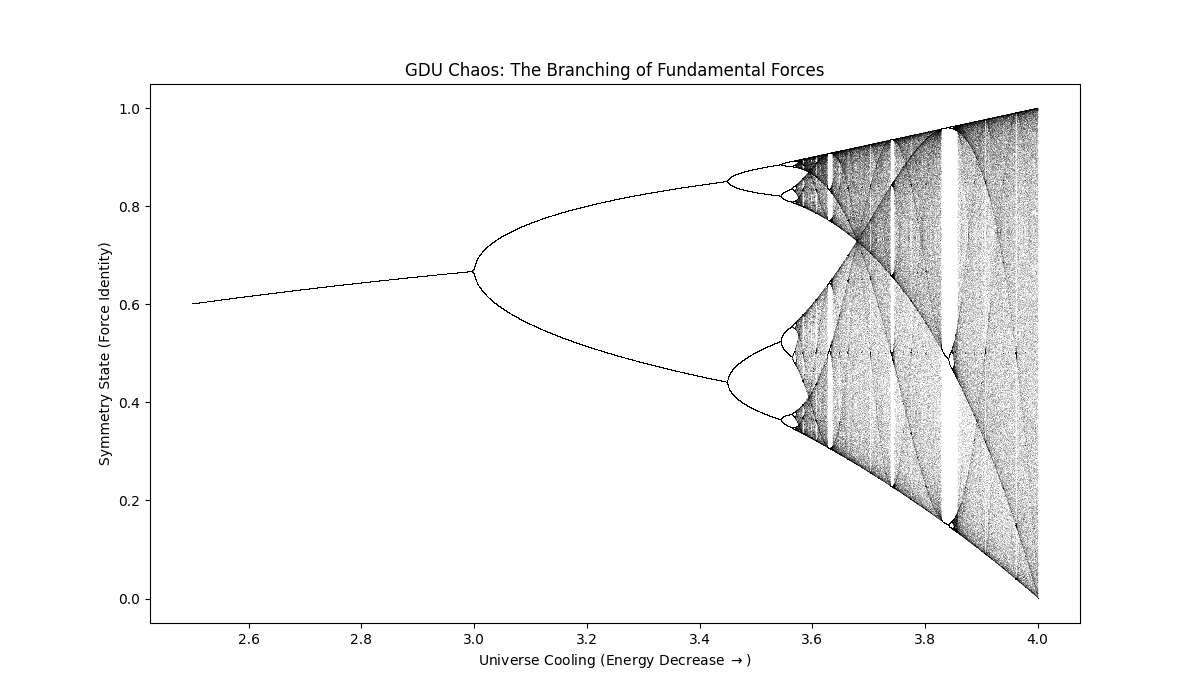
Figure 1: Fractal branching of the $SO(10)$ parent force on the Temporal Substrate.